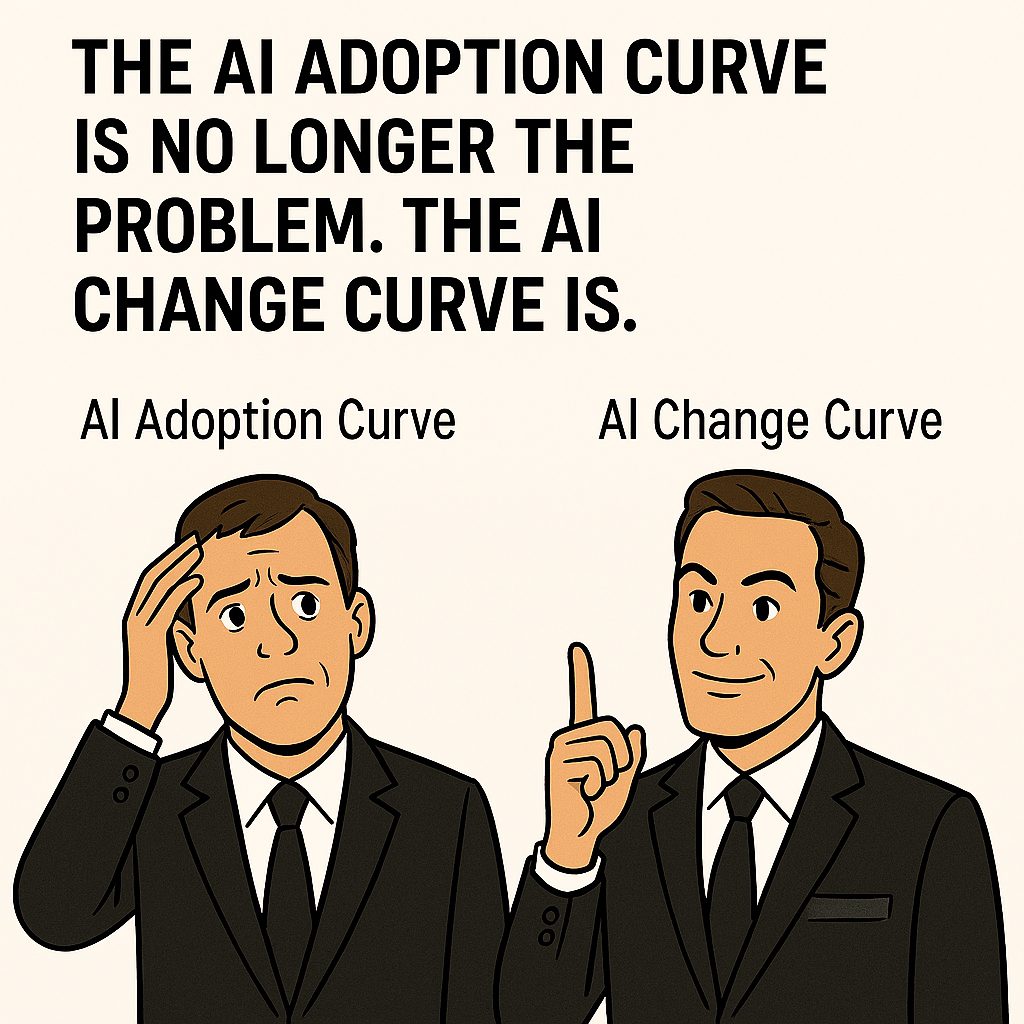
The AI Adoption Curve Is No Longer the Problem.
The AI Change Curve Is.
by BusinessGPS.ai
Reference: McKinsey - The State of AI in 2025
The latest state-of-AI data confirms what many leaders feel in their bones: AI is everywhere, but real transformation is still rare.
Nearly 88% of organizations now report regular AI use in at least one function, up from 78% the year before. That’s not a trend — that’s a tipping point.
And yet, for most companies, AI remains stuck in the “local wins” phase. The report states that nearly two-thirds haven’t begun scaling AI across the enterprise.
So what’s missing?
- It’s not the models.
- It’s not the tools.
- It’s not even the budgets — at least not first.
It’s the ability to change.
This is the quiet truth behind the new AI era:
Organizations don’t fail at AI because they can’t deploy it.
They fail at AI because they can’t embed it into the operating model fast enough to matter.
The Rise of Agents: Promise, Momentum, and the Reality Check
The report highlights the rapid emergence of AI agents — systems capable of planning and executing multi-step workflows in the real world.
Momentum is real:
- 23% say they are already scaling an agentic AI system somewhere in the enterprise.
- Another 39% are experimenting.
- So 62% are at least exploring agents.
But here’s the tell:
In any single function, no more than 10% report scaling agents.
That means we’re still early in the agentic journey. And early-stage adoption is where winners are made — or missed.
AI Is Already Improving Innovation — But EBIT Still Lags
This is one of the most important insights in the report:
- 64% say AI is enabling their innovation.
- But only 39% report any measurable enterprise-level EBIT impact — and most of those report under 5%.
Translation:
AI is already changing the game — but most companies haven’t yet changed the business.
This is the exact window where SMBs can outperform larger rivals. Because unlike the giants, they don’t need permission, multi-year programs, or legacy politics to move.
They need a reliable method.
What Separates AI High Performers?
McKinsey defines “AI high performers” as the small group (about 6%) who attribute more than 5% of EBIT to AI andreport significant value.
And what do they do differently?
- They aim beyond cost
Most companies target efficiency. High performers do too — but they also explicitly target growth and innovation.
- They redesign workflows
This is huge. High performers are nearly 3x more likely to fundamentally redesign workflows around AI.
- They scale agents faster
In most functions, high performers are at least three times more likely to have moved agents to scaling.
- They show real leadership ownership
High performers are about 3x more likely to strongly agree that senior leaders demonstrate true ownership and commitment to AI.
- They build the right foundations
Their practices span strategy, operating model, talent, data, technology, and adoption.
This is not a “tool adoption” story.
It’s a business rewiring story.
The Missing Link for Most Organizations: A Repeatable Changing Capability
The report says it plainly:
Many companies have rolled out tools, but haven’t yet productized use cases, redesigned workflows, or built the platforms and guardrails needed to run AI at scale.
That sentence is practically a diagnosis of why AI initiatives stall after the pilot phase.
Because scaling AI demands something most companies don’t formally manage:
Changing capability.
And that’s the exact lane where BusinessGPS.ai is positioned to lead.
How BusinessGPS.ai Turns AI Into a Transformation and Innovation Engine
BusinessGPS.ai isn’t just “AI strategy.”
It is a lifecycle operating system for turning strategy into execution — continuously.
Your O2O (Opportunity to Operations) Changing Capability standard process gives SMBs a structured way to:
- Choose the right AI opportunities,
- Align them to value streams and capabilities,
- Execute with measurable outcomes, and
- Embed the change into operations so the value compounds.
This directly mirrors what the report says high performers do:
- Ambition first (not just cost).
- Workflow redesign (not bolt-ons).
- Agent scaling guided by operating-model clarity.
- Leadership alignment and governance.
- Human-in-the-loop validation where needed.
In other words:
O2O is the bridge between agentic AI potential and measurable enterprise impact.
The O2O Advantage in the Agentic Era
Here’s the simplest way to frame it:
Most companies treat AI agents as tools.
High performers treat them as new operating capacity.
O2O is designed for that second mindset.
Because your process is built around three outcomes that executives actually care about:
- Capability: Do we have the business and technical ability to deliver outcomes?
- Capacity: Are we freeing bottlenecks and expanding throughput?
- Cash: Are we translating AI into real value and ROI?
This lets you do what the report implies is essential:
move from scattered use cases to a coherent enterprise (or business-unit) transformation narrative.
What “Agentic Transformation” Looks Like Through O2O
Here’s a practical mapping that’s easy to explain in client conversations:
Strategy (Opportunity)
- Identify where AI agents can create new growth paths or reshape the operating model.
- Define the transformation ambition early — the hallmark of high performers.
Portfolio Alignment
- Prioritize agent use cases by value stream impact + constraint removal.
- Avoid “random acts of AI.”
Execution
- Redesign workflows around agent+human co-production.
This is the shift the report links to real value.
Operations (Embedding)
- Turn “projects” into repeatable, scalable AI products.
- Build guardrails, governance, and human validation into normal work.
This is how you make AI durable, not just impressive.
Why this Matters Even More for SMBs
The report shows larger organizations lead in scaling AI.
the-state-of-ai-in-2025-agents-…
But that advantage is temporary.
Because SMBs that master changing capability can leapfrog the curve:
- less bureaucracy
- faster decision cycles
- more direct alignment between leadership intent and operational reality
With O2O plus smart agent design, SMBs can achieve something rare:
enterprise-grade AI transformation with SMB agility.
The Real Offer: “Change as a System”
If you want the positioning phrased sharply:
BusinessGPS.ai doesn’t just help you deploy AI.
It helps you industrialize change — so AI becomes a permanent innovation engine.
That is exactly the “high performer” pattern described in the report’s conclusions:
The winners treat AI as a catalyst for transformation, redesign workflows, and accelerate innovation rather than limiting the agenda to efficiency.
Call to Action: Start with Athena
If you want SMB leaders to move from interest to action, the first step must be low-friction, high-clarity, and value-forward.
That’s where Athena comes in.
Athena is your front-door transformation guide — a practical way for leaders to:
- Diagnose where they are on the AI scaling curve
- Identify the highest-value constraint and value-stream opportunities
- Understand where agents will create real capacity (not just novelty)
- Build an O2O-aligned path from strategy to operational embedding
Your invitation:
If your organization is using AI but not yet feeling enterprise-level momentum, don’t buy another tool.
Start by strengthening the capability that unlocks all the tools:
your ability to change — quickly, safely, and continuously.
👉 Try Athena to generate your AI + O2O Success Map.