Why the next 6-24 months will decide who builds capability, and who rents it
by BusinessGPS.ai
For most mid-market firms, AI is no longer an access problem.
They can buy copilots, model access, workflow tools, consulting support, and pilots. They can show the board a roadmap. They can run experiments across functions.
Yet many still cannot point to meaningful operating movement.
That is the real issue now: not access, but absorption.
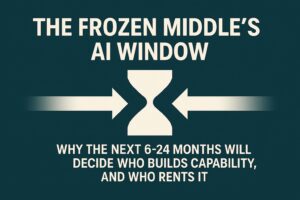
If Rich Schefren’s thesis is directionally right, we are in a short window, perhaps 6 to 24 months, where firms can still convert hard-won know-how into owned advantage before generic knowledge becomes cheap to imitate and distribute.
But the more dangerous risk for the frozen middle is deeper than content commoditization:
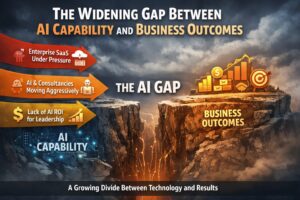
AI is improving faster than most organizations can absorb it, and the market is already reorganizing around that gap.
OpenAI has formalized Frontier Alliances with BCG, McKinsey, Accenture, and Capgemini to accelerate enterprise strategy, systems integration, workflow redesign, and scaled deployment. Anthropic has launched a $100 million Claude Partner Network to support enterprise adoption from pilot to production.
Those moves are structural signals. The commercial bottleneck is now implementation and organizational change, not model intelligence alone.
So the strategic question for a £50m-£500m business is not:
“Can we access frontier AI?”
It is:
“Can we absorb AI fast enough to build internal capability before dependence hardens?”
That is the game.
The frozen middle is exposed, not weak
These firms are large enough to need real transformation and to attract every vendor, consultant, SI, and implementation partner in the ecosystem.
But they are often not large enough to build deep in-house strength across strategy, architecture, data, governance, operating model redesign, and AI execution simultaneously.
So they sit in the most dangerous position:
- Too complex to adapt informally
- Too resource-constrained for endless transformation spend
- Too operationally stretched to redesign at the speed technology is moving
They are not weak businesses.
They are exposed businesses.
The bottleneck has shifted
Recent data supports the shift.
Gallup reported on January 25, 2026 that daily workplace AI use had reached 12%, frequent use 26%, while 49% of U.S. workers said they never use AI in their role. ISG’s 2025 enterprise AI study found only 31% of prioritized use cases had reached production and only 1 in 4 initiatives was achieving expected ROI on growth.
Interpretation:
- Adoption activity is rising
- Production conversion is still low
- ROI realization is uneven
That pattern is exactly what you see when organizations can buy capability faster than they can absorb it.
Boards ask,
“Where is the ROI?”
Underneath that question is the real one:
“Are we building capability, or renting intelligence?”
Why the partner moves matter
Many mid-market leaders still treat the OpenAI and Anthropic partner announcements as ecosystem news.
They are not ecosystem news. They are channel architecture.
Model firms know enterprise value is constrained by adoption friction. So they are strengthening the implementation layer: leadership alignment, workflow redesign, systems integration, governance, and change management.
For a £150m or £300m firm, this creates a real strategic fork:
- Use partners to accelerate capability transfer into your own operating system
- Or use partners to outsource judgment, architecture, governance interpretation, and integration ownership
Both paths can look “modern” in slideware.
Only one builds independence.
The risk is not that partners add no value. Many add substantial value.
The risk is incentive structure.
If the client-side capability strategy is weak, the default outcome is predictable:
- Externally designed workflows
- Externally interpreted governance
- Externally controlled integration logic
- Internally weak ownership
That is not transformation.
That is managed dependence.
The 6-24 month pattern: Choice -> Embedding -> Lock-in
1) Early window (first ~6 months): Choice
At this stage, leadership can still choose the game.
Not “do AI or don’t do AI.”
Choose whether AI is used to redesign live operating workflows, management routines, and decision rights, or simply layered on top of existing complexity.
The right questions here are operational, not performative:
- Where is decision latency damaging throughput?
- Where are management handoffs acting as translation bottlenecks?
- Which constraints are truly limiting value flow?
- What must remain client-owned even if we use partners for speed?
The biggest early mistake is broad ambition.
The frozen middle cannot afford an AI carnival.
It needs narrow intent:
a few constraints, a few workflows, a few bottlenecks, and hard ownership.
2) Mid window: Embedding
This is where most firms stall.
They have pilots, summaries, recommendations, dashboards, copilots, and experimentation narratives.
But they still have:
- The same meetings
- The same approval chains
- The same management drag
- The same human translation layers between signal and action
If AI has not changed how work actually moves, it has not changed economics.
So cadence must be measured in operating conversion, every 60-90 days, into one or more of:
- Lower cost
- Higher throughput
- Faster decisions
- Stronger control quality
If those do not move, the business is still in “assisted thinking.”
Useful, yes.
Strategically sufficient, no.
3) Late window: Lock-in
As the window progresses, dependence patterns harden.
The market split is not “AI users vs non-users.”
It is:
- Owners: building internal product ownership, reusable patterns, governed workflows, decision-right clarity, and capability transfer routines
- Renters: accumulating tools, vendors, pilots, and coordination overhead with weak internal muscle memory
Both groups look busy.
One compounds capability.
The other compounds spend.
Once an external partner becomes the only reliable source of redesign logic and integration judgment, you are no longer buying acceleration.
You are buying dependence with recurring cost and strategic drag.
By the far end of the window, generic knowledge gets cheaper
As models improve and distribution channels strengthen, static expertise and generic advisory packaging become easier to generate at lower marginal cost:
- Surface frameworks
- Generic best practice
- Standard process guidance
- Baseline strategic summaries
What remains scarce and valuable is different:
- Company-specific context
- Workflow design inside live operations
- Decision rights and governance architecture
- Embedded management judgment
- Proprietary feedback loops
- Repeated change absorption without operational breakage
So the right obsession is not,
“Will AI ingest all knowledge?”
It is:
“Can we convert knowledge into embedded advantage before knowledge itself is cheap?”
What cadence really means
Most teams treat cadence as pace of activity.
In this market, cadence means conversion speed from external AI progress into owned internal capability.
It has four layers:
- Strategic cadence: how often leadership re-decides where AI matters and where it does not
- Execution cadence: how quickly validated use cases move from experiment to governed workflow
- Capability-transfer cadence: how fast know-how shifts from external teams to internal managers and operators
- Governance cadence: how often value, risk, controls, bottlenecks, and decision rights are reviewed and reset
If any layer slows, drift begins.
And drift is expensive in a market where technology, partner capability, and buyer expectations are all accelerating.
What the frozen middle should do now
Not everything.
Do fewer things, more seriously.
A practical rhythm:
- Every 30 days: review top operational bottlenecks
- Every 60-90 days: embed one use case into live workflow with measurable movement
- Every quarter: test whether dependency is decreasing or increasing
- Every 6 months: redesign one part of the operating model, not just add another tool
Operating rules:
- Start with constrained workflows, not enterprise-wide ambition
- Separate experimentation spend from embedded capability investment
- Require every external engagement to transfer internal capability, not just deliver outputs
- Measure success in throughput, decision speed, control quality, and unit economics
That is cadence.
Not noise.
Not pilot accumulation.
Final thought
The next two years are not just a monetization window for knowledge.
They are a narrowing self-sufficiency window for mid-market firms.
- At the start of the window, you can still choose.
- In the middle, you need visible operating change.
- Toward the end, dependence starts to harden.
And by the far side, generic knowledge is cheaper while embedded capability is worth more.
AI output is becoming abundant.
Absorption is becoming scarce.
Scarcity is where value sits.
Where BusinessGPS fits
If your business is in the frozen middle, the answer is not a giant AI programme. It is disciplined cadence and capability ownership.
Start Right-30
Align the leadership team on where AI should and should not be applied, identify the highest-friction bottlenecks, and set an owner-led 90-day priority map.
Throughput-90
Embed AI into one constrained, high-value workflow and produce measurable movement in cost, throughput, decision speed, or control quality.
OpsMax-360
Build a repeatable operating system for sustained AI absorption: governance rhythm, capability transfer, reusable patterns, and decision-right clarity that compounds over time.
Because the prize is not access to AI.
The prize is becoming the kind of business that can absorb it faster than the market around it.