The Five As: Embedding AI in a Finance Operating Model — An Illustrative Worked Example
v0.2 · 19 October 2026 · First issued 1 September 2026 · Custodian: BusinessGPS · Version index and changelog
Position. AI does not embed in an operating model by being “added to finance.” It embeds one activity at a time, at a level of authority each activity has earned. The Five As name that spectrum of authority — Assist, Augment, Automate, Agentise, Autonomise — and this paper works the finance domain through it end to end: from a per-activity authority decision, across every element of the operating model canvas, and into a detailed target operating model. Autonomy is a destination some activities should never reach.
Executive summary
The operating model construction paper makes the case that an operating model can be built bottom-up from a single domain — finance is a powerful vertical slice through the whole enterprise — and elevated to the enterprise level through disciplined gates. This paper is its worked companion. It takes finance as the example domain and answers a narrower, more practical question: once you have a finance operating model, how do you decide how much authority AI should hold inside it, and how do you carry that decision through the whole model rather than bolting a tool onto one process?
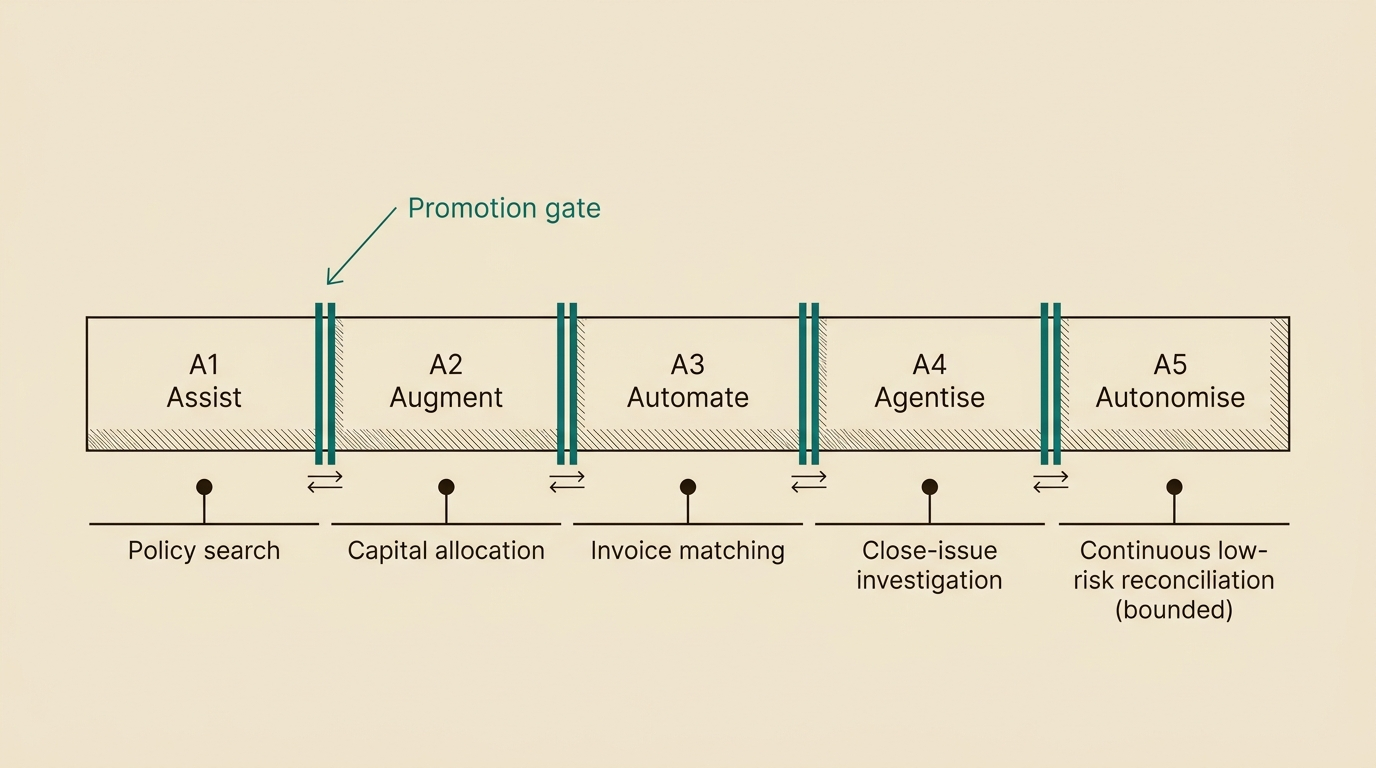
The instrument is the Five As. It is a five-level spectrum of AI authority applied to individual activities and decisions, not to the finance function as a whole:
- A1 — Assist: AI helps a person do the work; the person performs, verifies and decides.
- A2 — Augment: AI improves human analysis and judgement; the person still owns the decision.
- A3 — Automate: deterministic automation executes a defined, repeatable task within stable rules.
- A4 — Agentise: AI pursues a bounded outcome across several tasks, systems and handoffs; a person approves material conclusions.
- A5 — Autonomise: AI operates a bounded process within approved limits; a person owns policy, monitoring, intervention and shutdown.
The central discipline is that you apply this spectrum to activities, never to the function as a single maturity label — and that the fifth level is not the automatic destination. Some finance work must remain permanently at Assist or Augment because accountability, materiality or judgement cannot be safely delegated. The rest of the paper applies the spectrum across the operating model canvas, works two finance examples in full, and specifies the evidence that lets an activity be promoted to a higher level of authority — always earned, monitored and reversible.
1. What the Five As are — and are not
The Five As are a controlled way to decide how AI should participate in a piece of work, and then to translate that choice into the design of the operating model.
| Level | What it means | AI’s authority | The human’s position |
|---|---|---|---|
| A1 — Assist | AI helps a person perform work | Retrieves, generates or summarises information | Performs the work, verifies it and decides |
| A2 — Augment | AI improves human analysis and judgement | Analyses, detects patterns, recommends and challenges | Weighs the evidence and makes the decision |
| A3 — Automate | Deterministic automation executes a defined, repeatable task | Performs prescribed actions within stable rules | Owns the rules, monitors performance, handles exceptions |
| A4 — Agentise | AI pursues a bounded outcome across several tasks and systems | Plans and executes a controlled multi-step workflow | Approves material conclusions and actions; governs exceptions |
| A5 — Autonomise | AI operates a bounded process with limited intervention | Initiates permitted actions, monitors outcomes, adapts within approved limits | Owns policy, authority, monitoring, intervention and the shutdown |
Two rules govern the whole method. First, the unit of analysis is the activity or decision, not the function. No finance function is “at A4.” Its policy-search work may sit at Assist while its routine reconciliation sits at Automate and its close-issue investigation sits at Agentise. Second, the fifth level is not the goal. Progression toward autonomy is one option among five, justified only by evidence. Many finance activities should stay at Assist or Augment for good — the point of the spectrum is disciplined placement, not a ladder every activity is expected to climb.
2. Placing finance activities on the spectrum
The method starts from the work, not from the available tools. A first-pass placement across common finance activities looks like this — indicative, and always subject to the assessment in the next section:
| Finance activity | Indicative level | Why it sits there |
|---|---|---|
| Policy search and document summarisation | Assist | Retrieval and drafting aid; interpretation stays human |
| Management commentary and scenario analysis | Augment | AI can challenge and explain, but leaders own the narrative and the trade-offs |
| Invoice matching and routine reconciliations | Automate | Stable rules, high volume, repeatable |
| Close-issue investigation and evidence collection | Agentise | Multi-system, multi-step, bounded investigation |
| Continuous low-risk reconciliation | Bounded Autonomise | Only with trusted data, tolerances, full logs, monitoring and rollback |
| Material journal approval | Assist / Augment preparation | Segregation of duties and accountable approval stay human |
| Tax and accounting interpretation | Assist / Augment | Law, policy, context and professional judgement are material |
| External financial statements | AI-supported | Formal human and legal accountability remains |
| Treasury payments | Constrained Automate / Agentise | High-impact action demands strict limits and human authority |
| Impairment, provisions and going concern | Augment | Material uncertainty and judgement make autonomy inappropriate |
| Capital allocation | Augment | AI may model options; executives own ambition, risk and the resource decision |
The discipline in this table is this: no process earns an autonomy label just because one task inside it has been automated.
3. The placement questions
Before choosing a target level for any activity, work through twelve questions. They keep the decision anchored in outcome and control rather than in whatever AI product is to hand.
- What business or control outcome must improve?
- What is the governing constraint in the current flow?
- Which activities and decisions are actually involved?
- What evidence, data and context does each require?
- Where is professional or tacit judgement material?
- What is the impact of an error or an inappropriate action?
- Can the task be bounded by stable rules and authority limits?
- Is every action observable and traceable?
- Can the process stop safely and revert to a tested fallback?
- Who remains accountable, by name?
- What supplier or model dependency does this introduce?
- What measurable evidence would justify a promotion — or force a demotion?
Start with the outcome and the work design. Never start with the product.
4. Carrying the decision across the operating model canvas
A Five-As placement is not finished when the activity is labelled. Its consequences run across every element of the operating model canvas. This is what “embedding” actually means — and it is where the method connects to the construction paper’s federated architecture. We use the same POLISM elements.
P — Processes and value-delivery chains
The spectrum first classifies how work and decisions are performed. In a finance value stream that runs record-to-report, the levels look like this:
- Assist: retrieve accounting policy and prior treatments; summarise contracts, invoices and audit evidence; draft variance explanations and management commentary; prepare close summaries.
- Augment: detect anomalies, trends and control risks; recommend forecast adjustments; flag unusual journal patterns; generate scenarios and sensitivities; challenge inconsistent assumptions.
- Automate: match invoices and purchase orders; reconcile accounts under approved rules; classify standard transactions; generate defined recurring accruals; route exceptions to accountable owners.
- Agentise: investigate a reconciliation difference across authorised systems; gather and test supporting evidence; request missing information from the responsible team; develop and rank causal explanations; propose a correction and assemble an approval pack.
- Autonomise (within an approved low-risk boundary): monitor reconciliations continuously; resolve standard exceptions; initiate permitted immaterial corrections; update evidence and control records; escalate threshold breaches; and stop when a control boundary is breached.
The process-design rule is not “where can AI be inserted into record-to-report?” It is: what outcome must this value stream achieve, where is the constraint, which decisions require accountable judgement, and which Five-As treatment is justified for each activity?
O — Organisation
Each level changes what people do — but never removes accountability.
| Level | Organisation consequence |
|---|---|
| Assist | Roles stay; users need prompting, verification and information-handling skill |
| Augment | Roles shift from producing information toward interpretation, challenge and accountable judgement |
| Automate | Routine execution falls; exception ownership, rule stewardship and automation control rise |
| Agentise | People supervise cases and outcomes rather than every step |
| Autonomise | Process owners govern policy, thresholds, monitoring, intervention and improvement rather than routine execution |
The roles this tends to require include a finance process owner, an accounting-policy owner, a finance data owner, an AI-enabled control owner, an agent-capability owner, an exception-and-escalation owner, a model-risk or assurance role, a benefit owner, and a named human approver for material decisions. Removing human execution never removes human accountability.
L — Locations
- Assist and Augment: specialist knowledge becomes available across sites and business units; business partners get more consistent analysis; expertise depends less on physical proximity.
- Automate and Agentise: transaction processing shifts from shared-service queues toward continuous digital execution; shared services move from processing factories toward exception, control and improvement centres; regional teams keep jurisdiction-specific interpretation and approval.
- Autonomise: some low-risk work becomes location-independent; data residency, regulation, control and resilience matter more than labour arbitrage; alternative platforms and tested manual procedures are required for continuity.
AI does not automatically eliminate finance shared services. It changes their purpose and their capability mix.
I — Information
Each level makes a heavier information demand — and where the information cannot meet the demand, the activity should default downward toward Assist, not upward toward autonomy.
| Level | Information requirement |
|---|---|
| Assist | Accessible, current policies, definitions and controlled knowledge |
| Augment | Trusted history, contextual drivers and explainable analytical evidence |
| Automate | Structured data, stable rules, master data, thresholds and transaction lineage |
| Agentise | Cross-system permissions, process state, tool access and decision memory |
| Autonomise | Real-time signals, complete action logs, evaluation data, monitoring and safe rollback |
A finance AI information architecture should therefore cover: the finance vocabulary and semantic model; the chart of accounts and management hierarchies; transaction and master-data provenance; accounting policies and control rules; evidence and supporting documentation; human and agent permissions; agent context and institutional memory; decision and action logs; model, prompt, tool and version records; evaluation, exception and override data; retention, security and privacy controls; and reconciliation, correction and rollback capability.
S — Suppliers
Different levels lean on different supplier types — and the higher the authority, the harder the sovereignty conditions.
- Assist / Augment suppliers: model and copilot providers; accounting-content and research providers; analytics and planning platforms.
- Automate / Agentise suppliers: core finance-platform vendors; integration and workflow providers; agent-orchestration platforms; managed finance providers; specialist data, tax and audit services.
- Autonomy supplier requirements: explicit action and control boundaries; model, prompt and version traceability; complete decision and action logs; data and knowledge portability; alternative-model or alternative-provider capability; business continuity and manual fallback; liability and assurance provisions; audit and access rights; knowledge-transfer obligations; and exit, replacement and reversibility provisions.
The sovereignty test is a single question: if the platform or systems integrator disappeared, what would finance still understand, own, govern and operate?
M — Management System
The Management System is where the method lives. It decides which activities may sit where on the spectrum, and whether their authority may change. It governs permitted AI authority; process and decision risk classification; human approval and materiality thresholds; segregation of duties; data and model standards; validation, testing and assurance; monitoring, drift and exception handling; incidents, escalation and shutdown; benefit and capability realisation; supplier and platform dependency; fallback and recovery; and promotion, restriction and demotion between levels.
Its most important instrument is the set of authority-promotion gates — the evidence an activity must produce before it is allowed to move up a level:
| Movement | Minimum evidence |
|---|---|
| Assist → Augment | Recommendation quality, explainability, and demonstrably effective human challenge |
| Augment → Automate | Stable rules, reliable data, effective controls, and acceptable exception and error risk |
| Automate → Agentise | Safe tool use, bounded authority, end-to-end traceability, and tested escalation and fallback |
| Agentise → Autonomise | Sustained controlled performance, monitoring, rollback, resilience, and formal risk acceptance |
Authority must be earned, monitored and reversible. The governance discipline that holds these gates standing over time is Transformation Capability Management.
5. Worked example: account reconciliation
Take one activity through all five levels. Assume a current flow that is manual and linear: export ledger and subledger data → match transactions by hand → investigate unmatched items → request evidence from operational teams → prepare adjustments → obtain approval → record evidence → report completion.
Now apply the spectrum.
- A1 — Assist. AI retrieves policy, summarises prior exceptions, drafts evidence requests and prepares commentary. The analyst performs the reconciliation and makes every decision.
- A2 — Augment. AI proposes matches, highlights unusual ageing, ranks exceptions by risk and materiality, and suggests root causes. The analyst verifies the evidence and chooses the action.
- A3 — Automate. Automation completes exact and tolerance matching, closes routine matched items, applies approved classifications and routes exceptions. People own the rules and the material exceptions.
- A4 — Agentise. A reconciliation agent retrieves balances → applies approved matching rules → investigates unmatched items → searches authorised evidence → requests missing evidence → identifies likely causes → proposes adjustments → assembles the approval pack → records the trace. People approve material journals, unusual treatments and control exceptions.
- A5 — Autonomise. Within an approved low-risk boundary, the agent runs continuously, resolves standard exceptions, initiates permitted immaterial adjustments, updates evidence, monitors thresholds, and escalates or stops when a control is breached.
Across all five levels, the record-to-report process owner stays accountable for policy, materiality, performance and suspension. The authority moves; the accountability does not.
The target operating model for the reconciliation activity, once a level is chosen, reads across the TOM domains:
| TOM domain | Target-state example |
|---|---|
| Process | Continuous reconciliation with a risk-based exception flow |
| Capability | AI-enabled reconciliation and exception resolution |
| Organisation | Process owner, control owner, exception analyst, agent owner |
| Decision rights | Agent matches and resolves within tolerance; a human approves material adjustments |
| Information | Governed ledger and subledger data, rules, evidence and a decision trace |
| Application / AI | A reconciliation agent with bounded access to core systems and documents |
| Control | Segregation of duties, tolerances, an audit log, monitoring and a kill switch |
| Measures | Continuous reconciliation coverage, exception ageing, false-match rate, reviewer effort |
| Supplier | A provider subject to portability, assurance and exit requirements |
| Management System | Periodic authority review and evidence-based promotion or demotion |
6. Worked example: forecast-to-plan
The second example makes the “not every activity climbs the ladder” rule concrete. Forecasting carries material judgement, and will usually stop below full autonomy.
| Level | Forecasting application |
|---|---|
| Assist | Summarise business-unit submissions and external assumptions |
| Augment | Identify drivers, produce scenarios, challenge inconsistencies |
| Automate | Refresh standard calculations and consolidate submissions |
| Agentise | Collect inputs, investigate anomalies, run scenarios, recommend a baseline |
| Autonomise | At most, maintain a bounded rolling baseline — never approve commitments or capital allocation |
AI may maintain an evidence-backed baseline. Executives remain accountable for ambition, trade-offs, risk appetite, investment and resource allocation. Where reconciliation can, with enough earned evidence, reach a bounded autonomy, forecasting’s ceiling is set by the judgement inside it.
7. The design record every material activity needs
Placement is only real if it is written down and linked into the model. For every material activity or decision, retain a design record that captures: the finance activity and its current and target levels; the business outcome and the governing constraint; the named accountable owner; what the AI may do and what it explicitly may not do; the data, control and monitoring requirements; the fallback; the supplier dependencies; the capability owner; the promotion evidence; and the approval status.
An illustrative design record, in prose: for account reconciliation, suppose the current level is Augment and the target Agentise; the outcome is continuous control with reduced exception ageing; the governing constraint is manual investigation and evidence collection; the accountable owner is the record-to-report process owner. The agent may retrieve authorised data, match transactions, request evidence and recommend adjustments. It may not approve material journals, change accounting policy, or override segregation of duties. The fallback is a reversion to the approved manual reconciliation process; the capability owner is the finance AI capability owner; and the approval status would be held until promotion evidence exists. Stable identifiers should link this record to the finance value stream, the operating-model elements, the TOM components, the controls, the measures and the transformation-roadmap initiative.
The process view specifies what the AI does. It is necessary but not sufficient. Each material activity also needs a capability view — the enduring ability required and how humans, agents, information and controls supply it — and an ownership view — who can govern, improve, replace and reconstruct it. For reconciliation, the capability is financial reconciliation and assurance, delivered as a human-AI hybrid: humans contribute policy interpretation, materiality judgement and exception approval; the agent contributes matching, evidence retrieval and exception investigation; the capability is enterprise-owned; supplier dependency is bounded; the fallback is a human-led process; and there is a defined reconstruction-time target. The rule that ties it together: apply the Five As twice — once to process authority, once to capability provision — then make ownership, accountability, portability, fallback and reconstruction explicit.
8. Assurance — the anti-patterns to flag
An embedding is failing when any of these appear:
- an AI use with no business-outcome or governing-constraint rationale;
- a whole process or function labelled autonomous with no activity-level analysis;
- action authority with no named accountable human;
- an agent holding broader system permissions than its mandate requires;
- material decisions delegated without formal authority and an appeal route;
- autonomy without monitoring, rollback or a tested manual fallback;
- supplier-managed capability with no portability or exit path;
- productivity measures that ignore reviewer effort, migrated exceptions or control risk;
- promotion based on a successful demonstration rather than sustained operating evidence;
- AI placed only in the Information element while process, organisation and governance stay unchanged.
9. Where this sits in the O2O method
The Five As are both a design classification and an operating-governance mechanism, and they attach to specific points in the O2O sequence.
| O2O position | Five-As use |
|---|---|
| Step 1 — Business Context | Classify current work, judgement, workarounds, controls and AI usage |
| Step 2 — Business Goals | Define outcomes, guardrails, measures and acceptable authority boundaries |
| Step 3 — Business Change | Name the activities the change touches, and the authority each may need |
| Steps 4 to 9 — Platform strategy, then initiatives | Select the target level for each activity and reflect it across the POLISM elements in the target architecture (step 6); set the TOM and its named owners and the pre-projects (step 8), and turn the gaps into initiatives on a roadmap (step 9) |
| Portfolio and Execution (steps 10–18) | Build the capability, data, control and workforce initiatives the target level requires |
| Execution: step 18 cells (18.1–18.9) | Pilot at lower authority, test controls, and earn promotion evidence |
| Operations (steps 19–27) | Monitor outcomes, drift, overrides, reviewer load and supplier dependency; promote or demote |
10. The human boundary
AI can assist the assessment itself — extracting activities, mapping decisions, identifying control points, comparing options, simulating workload and checking traceability. But named humans retain authority for the target Five-As level; accounting policy; materiality and risk appetite; segregation of duties; data and tool permissions; workforce and supplier consequences; production release; promotion, restriction, suspension and shutdown; and the acceptance of residual risk.
An agent system must never approve its own authority level, its own control effectiveness, or its own promotion evidence. The gates are human gates by design.
11. The canonical principle
Apply the Five As first to finance activities and decisions, then translate their consequences across every element of the operating model canvas and into the detailed TOM. Promote authority only when evidence, controls, accountability, reversibility and organisational capability support it.
AI first changes the work in Processes. But durable embedding redesigns Organisation, Information, Suppliers, Locations — and, most of all, the Management System that governs how much authority AI may exercise. The method is platform-neutral, and it is not a claim that every finance process should progress toward autonomous operation.
Companion papers
- Operating Model Construction and Elevation — the flagship method this paper applies: how an operating model is built top-down, bottom-up and by convergence, and how a domain model elevates to the enterprise level. This paper is its finance-domain worked example.
- The Five-Layer Activity Model — where enterprise work sits; the diagnostic lens that identifies which finance activities carry the judgement that caps their Five-As level.
- TCM Discipline: The Missing Discipline — the standing governance discipline that holds the authority-promotion gates and owns promotion, restriction and demotion over time.
Version index and changelog
- v0.2 (19 October 2026): wording, O2O step names and references aligned with the published method; no argument changed; before publication, “level 4” written as “A4” so it cannot be read as a layer or process level, the method table corrected to place the target architecture at step 6, the TOM and named owners at step 8, and the roadmap at step 9, and the companion papers cited at the versions being published (v0.4 and v3.2).
- v0.1 (1 September 2026).
From BusinessGPS source R&D.