Layer 3: The Workaround Layer — Discovery as Capability Recovery
v0.3 · 19 October 2026 · First issued 1 September 2026 · Custodian: BusinessGPS · Version index and changelog
Position. Layer 3 is the unofficial operating system of the enterprise: the human adaptations, shadow tools, informal relationships, and privately held operational knowledge required to make the formal operating model work. Its discovery is capability recovery, not knowledge extraction. A workaround is not automatically waste and not automatically an asset — it must be surfaced through evidence, classified by type and by Signature/Core/Context posture, and given a deliberate disposition. And no workaround that carries judgement, exceptions, or authority may become executable agent logic until it has passed through the Layer 4 legitimacy gate.
Executive summary
The Five-Layer Activity Model classifies every enterprise activity by where the work is performed — from Layer 1 (system behaviour) up to Layer 5 (the top layer, Agentic Potential in the published model). Of the five, Layer 3 receives the thinnest treatment: one row in the summary table, a handful of paragraphs. That is a problem, because Layer 3 is where the enterprise’s real operating reality lives, and because getting Layer 3 wrong is a common way that ambitious automation programmes destroy value they meant to create.
This paper promotes Layer 3 to full depth. It makes six moves.
First, it defines Layer 3 as the Workaround Layer — the unofficial operating system that determines whether the formal process actually succeeds. Second, it reframes discovery as capability recovery: the goal is not to strip knowledge out of people’s heads, but to recover, distinguish, and protect the capability that keeps the organisation running. Third, it establishes that discovery must draw on six evidence channels, because interviews alone systematically miss the steps experts have stopped noticing. Fourth, it specifies the Workaround Record as the canonical, evidence-linked Layer 3 object. Fifth, it sets out the classification and disposition logic — every workaround is typed, given a Signature/Core/Context posture, and assigned a deliberate outcome. Sixth, it defines the Layer 3 to Layer 4 to Layer 5 legitimacy gate, the control that stops observed behaviour from being promoted straight into automated authority.
Where The Five-Layer Activity Model says where enterprise work sits, and TCM Discipline names the discipline that governs change, this paper answers a narrower and more practical question: how do you actually surface the third layer, and what do you do with what you find?
1. Why Layer 3 needs its own paper
The Five-Layer Model earns its diagnostic power by drawing a line between what is documented (Layers 1 and 2) and what is not (Layers 3 to 5). Layer 3 sits immediately beneath that line — the first layer of undocumented work, and the one every transformation programme brushes against without ever properly describing.
The consequence of leaving it thin is specific. You cannot automate work you have not described, and Layer 3 is precisely the work nobody has described. When a programme designs end-to-end automation from Layer 1 system behaviour and Layer 2 formal procedures alone, it is designing against a fiction — the operating model the organisation thinks it has, not the one it actually depends on. The real operating model is carried in private spreadsheets, local trackers, manual reconciliations, informal escalation paths, duplicate data entry, personal contact networks, and undocumented routines. This paper gives that layer the definition, the discovery method, the object model, and the governance it needs to be treated as evidence rather than noise.
A reminder on the axis, so this paper stays consistent with its parent: the five layers describe WHERE work is performed, not WHO performs it. Layer 3 is not “the analysts” and Layer 4 is not “the managers.” A single person routinely operates across layers within a single task — executing a system step (L1), following a procedure (L2), applying a private workaround (L3), and exercising judgement about an exception (L4). Keeping the axis on where the work happens is what lets a workaround (L3) be cleanly separated from the judgement it sometimes carries (L4), which is the distinction the legitimacy gate later depends on.
2. Layer 3 is the unofficial operating system
Formal systems and formal procedures describe the operating model the organisation has chosen to publish. Layer 3 is the operating model it actually runs. The two are rarely the same, and the gap between them is not disorder — it is the accumulated set of adaptations people made so that the published model could survive contact with reality.
Layer 3 is heterogeneous, and treating it as one undifferentiated pile of “shadow IT” is the first mistake. A mature reading distinguishes at least the following kinds of workaround:
| Workaround type | What it is | Why it matters |
|---|---|---|
| System bridge | Manual movement of data between systems that do not integrate | Often mission-critical; breaks silently when the person leaves |
| Data repair | Cleaning, reconciling, or correcting data the system produces wrong | Compensates for a Layer 1 master-data failure |
| Exception route | An informal path for cases the standard process cannot handle | Encodes real business rules never written down |
| Hidden control | A check someone runs that no procedure mandates | Frequently the only thing preventing a known failure |
| Coordination mechanism | Informal relationships and contacts that make handoffs work | Pure institutional knowledge; invisible to any system |
| Capability asset | A genuinely distinctive way of doing the work | May be a signature capability wearing a spreadsheet’s clothes |
| Judgement carrier | A routine that embeds prioritisation, trade-off, or override | Belongs to Layer 4, not Layer 3 — must be routed, not automated |
| Policy circumvention | A bypass of a formal rule or control | May be rational, may be risk; must be surfaced blamelessly |
| Obsolete scar tissue | A routine that outlived the problem it solved | Safe to eliminate — but only once confirmed obsolete |
The practical point is that these types have different correct dispositions. A hidden control must be preserved or formalised; obsolete scar tissue should be eliminated; a system bridge should usually be repaired upstream; a capability asset must be protected and owned; and a judgement carrier must be escalated to Layer 4 rather than hard-coded into an agent. You cannot decide any of that until you have surfaced the workaround and named its type.
3. Discovery as capability recovery, not knowledge extraction
The framing matters because it changes both the ethics and the results of the work.
“Knowledge extraction” tells the person at the keyboard that the objective is to remove what is in their head so the organisation no longer needs them there. That framing is not paranoid — it is often a rational read of what standardisation programmes have historically done. People may reasonably interpret knowledge capture as a prelude to automating their job, exposing a policy bypass they have quietly maintained, losing status, having unrecognised expertise appropriated, or seeing management standardise work it does not understand. Resistance under that framing is not obstruction. It is a correct response to a real risk.
Capability recovery reframes the objective. The organisation is not trying to strip capability out of people; it is trying to recover capability it has been depending on without knowing it, distinguish the parts that are waste from the parts that are genuinely valuable, and decide deliberately what to do with each. Under this framing, the person at the keyboard is not a resource to be drained — they are the custodian of operating knowledge the organisation needs to make good decisions.
This reframing has to be backed by an explicit participant compact, or it is just nicer language over the same threat. The compact commits the programme to:
- Blameless discovery — surfacing a workaround, including a policy circumvention, never triggers blame for the person who built it.
- Contributor review — the person who holds the knowledge reviews how it has been recorded before it is used.
- Provenance and credit — recovered capability is attributed; expertise made visible is recognised, not anonymised.
- Transparent role transition — where a workaround is automated or transferred, the consequence for the person’s role is discussed openly, not sprung on them.
- Separation of discovery from rule-making — being observed doing something is not the same as that something being adopted as policy. Discovery records what happens; it does not, by itself, authorise anything.
That last commitment is not only ethical hygiene. It is the same firewall the legitimacy gate later enforces at the system level (Section 8).
4. The six evidence channels
Interviews alone are insufficient, and this is the premise the method rests on. Experienced people omit the steps that have become automatic or obvious to them — not to deceive, but because genuine expertise is largely tacit and retrieved through specific situations rather than stated as general rules. Ask an expert “what do you do?” and you get the published process; watch what they actually do and you get Layer 3.
Discovery therefore combines six evidence channels, each catching what the others miss:
| Channel | What it surfaces | What it catches that interviews miss |
|---|---|---|
| Digital archaeology | Spreadsheets, local files, macros, personal trackers, mailbox rules | The tools people forgot they built |
| Process and task mining | Actual system-interaction and click-path sequences | The real path, not the documented one |
| Work-along observation | The steps performed in situ, in real time | Automatic steps the operator no longer notices |
| Critical incident reconstruction | How a recent exception was actually resolved | The judgement and improvisation used under pressure |
| Absence and dependency testing | What breaks when a person, file, or contact is unavailable | The single points of failure nobody flagged |
| Operator self-capture | The workaround recorded by the operator at the moment it occurs | The routine that is invisible until it is triggered |
No single channel is sufficient, and the combination is deliberately triangulating: process mining shows that a workaround exists, work-along observation shows how it is done, critical-incident reconstruction shows why, and absence testing shows how much it matters. Operator self-capture, backed by the participant compact, turns the person from a subject of the study into a collaborator in it.
5. The Workaround Record — the canonical Layer 3 object
Everything discovered is captured as a structured, evidence-linked object: the Workaround Record. It is to Layer 3 what a well-formed evidence card is to the rest of the method — the atomic unit that makes the layer analysable rather than anecdotal.
A Workaround Record captures:
| Field | Content |
|---|---|
| Trigger | The event or condition that causes the workaround to be performed |
| Actions | The actual sequence of steps taken |
| Systems | The systems, tools, and files touched |
| People | The individuals and roles involved, including informal contacts |
| Information transformations | What data goes in, what comes out, and how it is changed |
| Dependencies | What the workaround relies on to function |
| Frequency and delay | How often it runs and how long it takes |
| Risk | What happens, and how badly, when it fails or is skipped |
| Judgement content | Any prioritisation, exception, trade-off, or override embedded in it |
| Provenance | The evidence channels that surfaced it, with links |
| Classification | Workaround type, and Signature / Core / Context posture |
| Disposition | The approved outcome (see Section 7) |
| Validation state | Whether the record has been contributor-reviewed and confirmed |
The judgement content field is load-bearing. It is the flag that says a given workaround is not purely mechanical — that it carries a decision which belongs to Layer 4 and must not be silently converted into automated logic. A Workaround Record with a populated judgement field cannot proceed to automation on the Layer 3 track alone; it is routed to the legitimacy gate.
6. Classification: type and Signature/Core/Context
Every Workaround Record is classified on two independent dimensions before any disposition is decided.
The first dimension is workaround type (the taxonomy in Section 2), which tells you what kind of thing you are looking at. The second is the Signature / Core / Context posture, which tells you what the thing is worth to the enterprise:
- Signature — a workaround that encodes something genuinely distinctive to this business: a capability that is a competitive moat, or a constraint-born necessary uniqueness the organisation’s specific situation demands. Signature workarounds are the ones fit-to-standard programmes most often destroy by mistake, because they look like non-standard mess. They must be recovered and owned.
- Core — a workaround that is essential to operate but not distinctive: important, but not a source of advantage. Core workarounds are candidates for formalisation, upstream repair, or automation once legitimate.
- Context — a workaround that is necessary overhead with no strategic value. Context workarounds are the strongest candidates for elimination, transfer, or automation.
The two dimensions are orthogonal and both are required. A hidden control (type) may be Signature in one firm and Context in another; a data repair (type) that looks like pure overhead may be masking a Signature capability the organisation has never named. Classifying on type alone tells you how the workaround behaves; classifying on Signature/Core/Context tells you how much it matters. You need both to choose a disposition well.
7. Disposition: what to do with each workaround
Classification precedes disposition, and automation is one possible outcome, not the default. This is the discipline that separates capability recovery from a naïve “automate everything you find” programme. The approved disposition for a Workaround Record is one of:
| Disposition | When it applies |
|---|---|
| Eliminate | The workaround is obsolete scar tissue, or Context overhead the enterprise no longer needs |
| Repair upstream | The workaround compensates for a Layer 1 or Layer 2 defect that should be fixed at source |
| Formalise | The workaround is a legitimate routine that should become a documented, versioned procedure |
| Integrate | The workaround should be absorbed into the formal system or process design |
| Control | The workaround is a hidden control that must be recognised, owned, and governed |
| Preserve | The workaround is a Signature capability to be protected and deliberately retained |
| Transfer up (to Layer 4) | The workaround carries judgement, exceptions, or authority and belongs in the judgement architecture |
| Automate | The workaround is legitimate, well-understood, and safe to convert into agent logic |
| Deliberately retain | The workaround is best left as human work for now, by explicit decision |
Two dispositions deserve emphasis. Preserve exists because the most valuable Layer 3 content is frequently a signature capability wearing a spreadsheet’s clothes — and a programme optimised for standardisation will eliminate it unless the method explicitly protects it. Transfer up exists because a workaround that embeds a real decision is not a Layer 3 automation candidate at all; it is Layer 4 evidence, and pushing it straight into an agent would hard-code an unauthorised judgement into the operating model. Transfer-up is the on-ramp to the legitimacy gate.
8. The Layer 3 to Layer 4 to Layer 5 legitimacy gate
This is the governance spine of the whole method, and the single most important control in the paper.
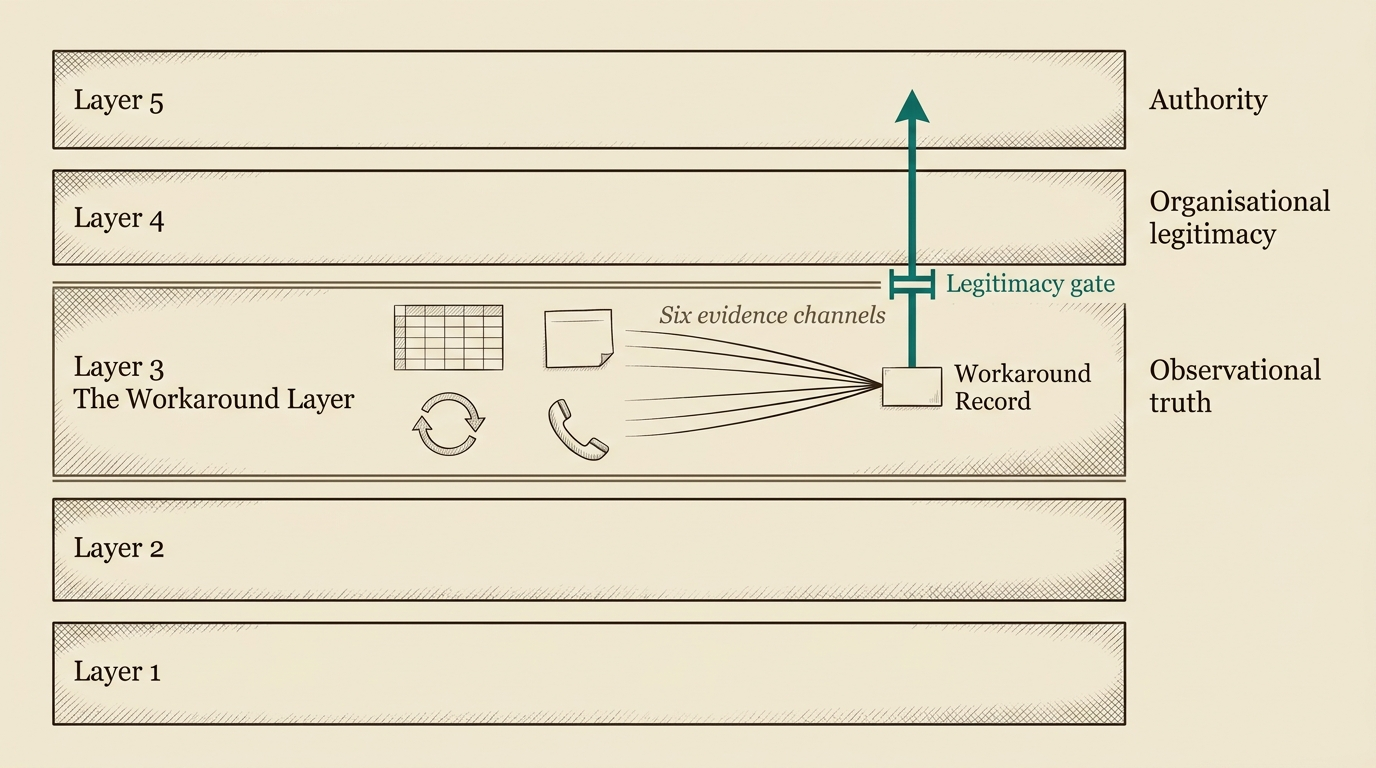
Layer 3 supplies observational truth: evidence of how work actually happens. It does not, by itself, supply authority. The fact that a workaround is common, that it usually produces a good outcome, that everyone seems to agree with it, or that an agent recommends it, does not make it legitimate policy. Any workaround that contains prioritisation, exceptions, risk trade-offs, standards, or overrides must pass through Layer 4 ratification before it can become executable agent logic at Layer 5.
The governing formulation is:
Layer 3 supplies observational truth. Layer 4 supplies organisational legitimacy. Only then can Layer 5 receive authority.
The full loop, stated as prose so it survives on any screen: Layer 3 reveals how the organisation actually behaves → the organisational pattern behind the behaviour is explained → relevant leadership behaviour and corrections are interpreted → Layer 4 determines what is legitimate and authorised → that judgement is applied and contested in a specific case, producing an auditable decision record → Layer 5 acts within earned bounds → and outcomes, together with any new workarounds that emerge, feed back to update the system.
Around this loop sits an authority firewall. Its job is to guarantee that none of the following can silently become corporate policy: an individual’s personal preference; a workaround that merely happens to be common; an apparent organisational consensus that was never actually decided; an agent’s recommendation; or a single successful outcome. Each of these is a plausible-looking shortcut into automated authority, and each is blocked by design. The firewall is the system-level expression of the same “separation of discovery from rule-making” that the participant compact promised the individual (Section 3).
9. From Layer 3 evidence to agent-ready capability
When a workaround’s disposition is automate — and only after it has cleared the legitimacy gate if it carries judgement — codification for AI requires substantially more than writing an SOP. Turning a recovered capability into governed, testable agency requires an agent-ready capability pack: machine-readable task and event sequences; evidence and data contracts; tool permissions; explicit rules with representative and boundary cases; judgement rubrics where discretion remains; authority limits; abstention and escalation rules; outcome measures; evaluation sets; and audit, rollback, and kill-switch controls.
The point of listing all of this is to make clear that automation is not the finish line of Layer 3 work — it is a demanding, governed downstream activity that only a minority of well-understood, legitimate, low-judgement workarounds should reach. Most Layer 3 findings are better served by eliminate, repair, formalise, control, or preserve. A programme whose Layer 3 output is overwhelmingly “automate” has almost certainly skipped the classification discipline.
Bounded decision models (added 30 September 2026). A new class of model may change one input to this disposition. This is a hypothesis. TypeSafe’s Jev, launched in early access in a post dated 15 September 2026 and described by its maker as a “System One Model”, returns a constrained decision with a confidence score. Its maker sells it for decisions “where hand-written logic is too brittle”. Two of the workaround types in Section 2, the exception route and the judgement carrier, often exist for that reason. The decision was too fuzzy for configured rules, so a person took it by hand. The hypothesis is that some of those decisions can now run inside the system. Two limits follow from this paper’s own method. A model cannot be given a decision nobody has surfaced, so the Workaround Record comes first. And a workaround that carries judgement still has to pass the legitimacy gate in Section 8. A model’s confidence is meant to say how likely it is to be right. It does not say whether anyone has authorised it to decide. The test is to classify the same set of workarounds with and without such models available, and compare the dispositions.
10. Where this sits in the O2O method
Layer 3 discovery is not a one-off exercise; it is a mandatory evidence stream that runs across the O2O lifecycle:
| O2O position | Layer 3 use |
|---|---|
| Strategy (steps 1–9) | Identify the divergence between the formal and the actual operating reality |
| Portfolio and Execution (steps 10–18): prioritise | Prioritise workarounds by constraint impact, risk, management load, and strategic value |
| Portfolio and Execution (steps 10–18): discover | Build the Workaround Registry and the actual-work map from the six evidence channels |
| Portfolio and Execution (steps 10–18): decide | Approve the eliminate / formalise / preserve / transfer-up / automate dispositions |
| Portfolio and Execution (steps 10–18): design | Build the agent-ready capability pack for automation-bound items |
| Portfolio and Execution (steps 10–18): prove | Replay historical cases, run shadow mode, and test the operating boundary |
| Operations (steps 19–27) | Monitor for new workarounds, drift, exceptions, and bottleneck migration |
The registry structure that results is deliberately three-layered and linked: a Workaround Registry at Layer 3, a Judgement Registry at Layer 4, and a registry at the top layer (Layer 5) recording what agents are authorised to do. The links between them are the audit trail that proves a piece of automated authority traces all the way back to observed evidence, through an authorised decision, to a bounded agent — and never jumped a layer.
11. Anti-patterns
Avoid: treating all of Layer 3 as waste to be eliminated (much of it is capability); treating all of Layer 3 as sacred knowledge to be preserved (much of it is scar tissue); relying on interviews alone and calling the result a discovery; automating a workaround that carries judgement without routing it through Layer 4; letting an apparent consensus, a common practice, or one good outcome become policy without ratification; framing the work as knowledge extraction and then being surprised by rational resistance; recording workarounds without a contributor review step; and treating an SOP as sufficient codification for an agent.
12. The canonical principle
Layer 3 is the unofficial operating system the enterprise actually depends on. Its discovery is capability recovery: surface every workaround through multiple evidence channels, capture it as an evidence-linked Workaround Record, classify it by type and by Signature/Core/Context, and give it a deliberate disposition. Observed behaviour is truth, not authority — any workaround carrying judgement must earn legitimacy at Layer 4 before it can receive automated authority at Layer 5.
This is what turns “we found a lot of spreadsheets” into a governed pipeline from operating truth to owned, testable capability — and it is what stops a well-meaning automation programme from hard-coding an organisation’s most valuable, least visible capabilities out of existence.
Companion papers
- The Five-Layer Activity Model — the parent framework; this paper is the depth-dive for its Layer 3 row.
- Operating Model Construction and Elevation — how domain evidence (Layer 3 discovery included) is elevated into an enterprise operating model.
- TCM Discipline: The Missing Discipline — the discipline that governs the discovery, classification, and legitimacy controls described here.
Version index and changelog
- v0.3 (19 October 2026): wording, O2O step names and references aligned with the published method; no argument changed.
- v0.2 (30 September 2026): one paragraph added to Section 9 on bounded decision models (TypeSafe’s Jev), stated as a hypothesis. Paragraph by Apollo.
- v0.1 (1 September 2026).
From BusinessGPS source R&D.